


Allagash Wilderness Waterway coldwater monitoring: Fall 2026 field report
Multiple trips to the Allagash Wilderness Waterway completed the fieldwork for the final year of the AWWF’s Coldwater Fish Habitat Temperature Monitoring project.
Abnormally low water flows throughout late summer of 2026 continued through the early fall period and delayed efforts to retrieve temperature loggers. Roadside, easily accessible loggers in tributaries to AWW headwater lakes were visited on September 30th, October 2nd, and October 5th; a final canoe trip on November 8–9 was necessary to retrieve loggers in Allagash River tributaries.
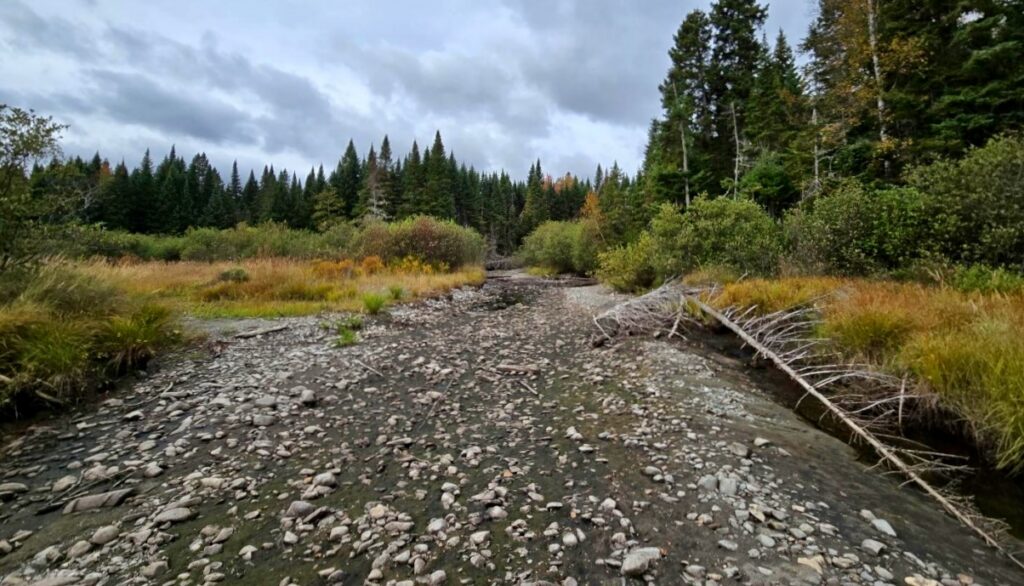
Five logger sites were visited in late September and early October. Data from these loggers were downloaded, except for Churchill Brook, which had a dead battery, and Glazier Brook, which could not be located. Water levels were extremely low during this period, though only one logger — in Allagash Stream — was dewatered. Churchill Brook had an exceptionally low flow with a dry channel for several hundred feet beginning at the confluence with Churchill Lake (see above photo).
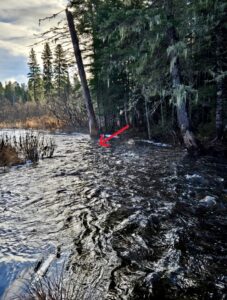
The remaining loggers not accessed during the early October trip were visited on a November 8–9 canoe trip. This time, flows were significantly higher than normal, which made some of the larger tributaries difficult to access. The Schedule Brook site had remarkably high water, so the logger could not be safely approached (see photo). The flow in Musquacook Stream was also very high and heavily altered by beaver activity; the site could not be accessed, and it appeared a beaver dam had been built directly on it. Overall, data was collected from 13 loggers deployed for the 2026 season. No loggers were redeployed, as this is the last year of the project.
It is noteworthy that of the 12 logger sites visited on November 8–9, eight had significant beaver activity at or near the tributary confluences. Thoroughfare Brook, Shepherd Brook, Savage Brook, and the Unnamed Brook at Cunliffe Depot were the only tributaries without noticeable beaver activity.